Zunqerai
Free Kit
Free Kit
Couldn't load pickup availability
- Problem Statement
Many learners meet databases as a group of unfamiliar words: table, record, field, key, relation, query, filter, and join. These words can feel separate at first, especially when there is no visual or written structure around them. A learner may understand one definition but still not see how the pieces work together inside a database. Another common issue is that examples can become too technical before the basic logic is settled. Free Kit is created for this early stage, where the main need is a grounded introduction, not pressure or overloaded content.
- Solution
Free Kit gives learners a small and organized first look at database foundations. The materials focus on simple database concepts, short explanations, and small tasks that help connect terms with practical meaning. Instead of covering many advanced topics at once, this tier keeps attention on the first building blocks. Learners can review the same ideas more than once and use the examples as a quiet reference point. This makes Free Kit a useful opening tier before moving into wider Zunqerai course materials.
- What’s Inside
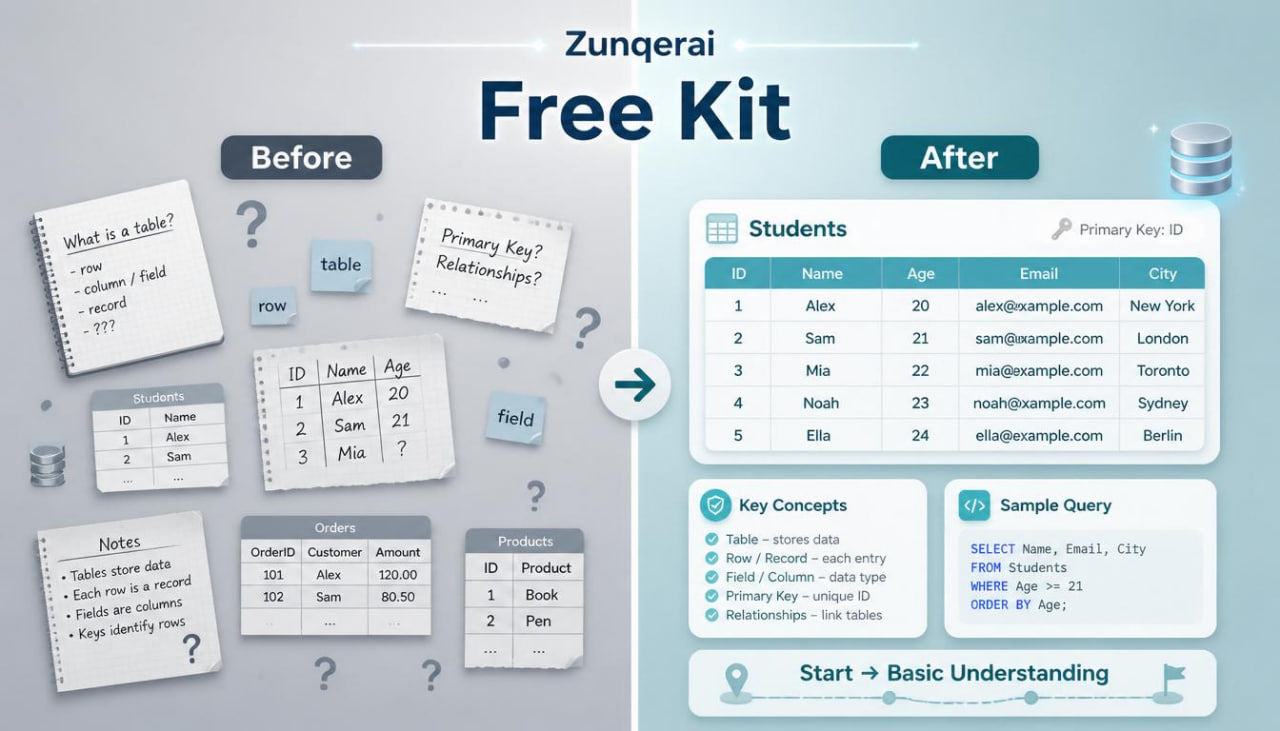
Free Kit includes introductory database learning materials built around the first layer of data organization. The content starts with the idea of a table as a place where related information is arranged in rows and columns. It explains how a row can represent one item, entry, or record, while a column can describe one type of information connected to that record. This helps learners understand why databases are organized in a structured format rather than as loose notes.
The tier also introduces fields and records in a clear way. A field is presented as a named part of information, while a record is shown as a full entry made from several fields. For example, learners may see how a small contact list, book list, order list, or study tracker can be arranged as database-style information. The examples stay neutral and focused on structure, so the learner can pay attention to the idea rather than outside details.
Free Kit also includes a short section about primary keys. This part explains why one value may be used to identify a record inside a table. The material does not overload the learner with advanced theory. Instead, it shows why duplicate or unclear entries can create confusion and how a key can help keep records organized.
Another part of the tier introduces relationships between tables. Learners meet the idea that one table can describe one group of information, while another table can describe related information. For example, one table may describe learners, while another table may describe tasks. The material explains how a shared value can connect those tables. This section is only an introduction, but it helps prepare the learner for later topics.
Free Kit also includes a small query introduction. Learners meet the idea of asking a database for certain information. The materials describe basic query thinking: selecting information, narrowing results, sorting entries, and reading structured output. The examples are written as learning prompts rather than complex technical scripts.
A glossary-style section is included to help learners return to key terms. It covers words such as table, row, column, field, record, key, relationship, query, filter, and sort. Each term is explained in plain language. The glossary can be used while reading the other parts of the tier.
The tier also contains short practice tasks. These tasks may ask the learner to identify fields in a sample table, choose a suitable key for a small data set, describe how two tables could be related, or write a plain-language query request. The tasks are not framed as tests. They are study prompts that help the learner think through the material.
Free Kit may also include recap notes at the end of sections. These notes restate the main ideas in a shorter format. They are useful for review after reading the longer explanations.
- Who Is This For?
Free Kit is for learners who want to begin studying database concepts in a light and structured way. It is suitable for people who have heard database terms before but want a clearer first explanation. It is also suitable for learners comparing Zunqerai tiers and wanting to see how the materials are written.
This tier may be useful for students, self-paced learners, small business owners organizing information, team members working with structured records, or anyone curious about how data can be arranged. It does not require previous study in database design. It is also a good starting point for learners who prefer written materials, examples, and practice prompts over noisy marketing claims.
Free Kit is not meant to cover every database topic. It is a starting sample with a focused scope. Learners who want more topics, deeper explanations, and wider practice can move to a larger Zunqerai tier later.
- What You Will Learn
- What a database table represents.
- How rows and columns organize information.
- The difference between fields and records.
- Why a key can help identify a record.
- How two tables can be connected through a shared value.
- What a query is in plain study language.
- How filtering and sorting relate to database thinking.
- How to read small structured examples.
- How to describe a small data set using database terms.
- How to begin building a study vocabulary for later modules.
- 30-Day Refund Note
Free Kit has no charge, so a refund is not needed for this tier. For paid Zunqerai tiers, a 30-day refund request window may be listed in the store policy. Refund handling depends on the store’s written terms, order status, and file delivery conditions. Please read the refund policy on the store before placing an order for a paid tier.
Self-paced learning overview
- 🗂️ Digital file available after purchase
- 📚 Long-term availability
- 🔐 Secure checkout
- 📝 Content updated in 2026
What format are the Zunqerai materials provided in?
What format are the Zunqerai materials provided in?
Zunqerai database course materials are provided as digital learning files. They are created for reading, study, practice, and review at your own pace. The materials may include modules, written explanations, examples, tables, tasks, recap notes, and glossary-style sections. Each tier has its own content range and topic depth.
Do I need previous database knowledge before studying?
Do I need previous database knowledge before studying?
No previous database study is required for the starting tiers. Some tiers begin with basic ideas such as tables, fields, records, keys, relationships, and query structure. Wider tiers may include more detailed topics, so learners can choose the tier that matches their current study needs. The materials are written to support gradual learning through examples and practice.
How do I receive the materials after placing an order?
How do I receive the materials after placing an order?
After placing an order, the learning files are provided through the store’s delivery flow or order details message. The exact delivery method may depend on the store setup. You can use the provided files for personal study, reading, note-taking, and practice tasks. Each tier description explains what type of materials are included.
Share