Zunqerai
Flow Capsule
Flow Capsule
Couldn't load pickup availability
- Problem Statement
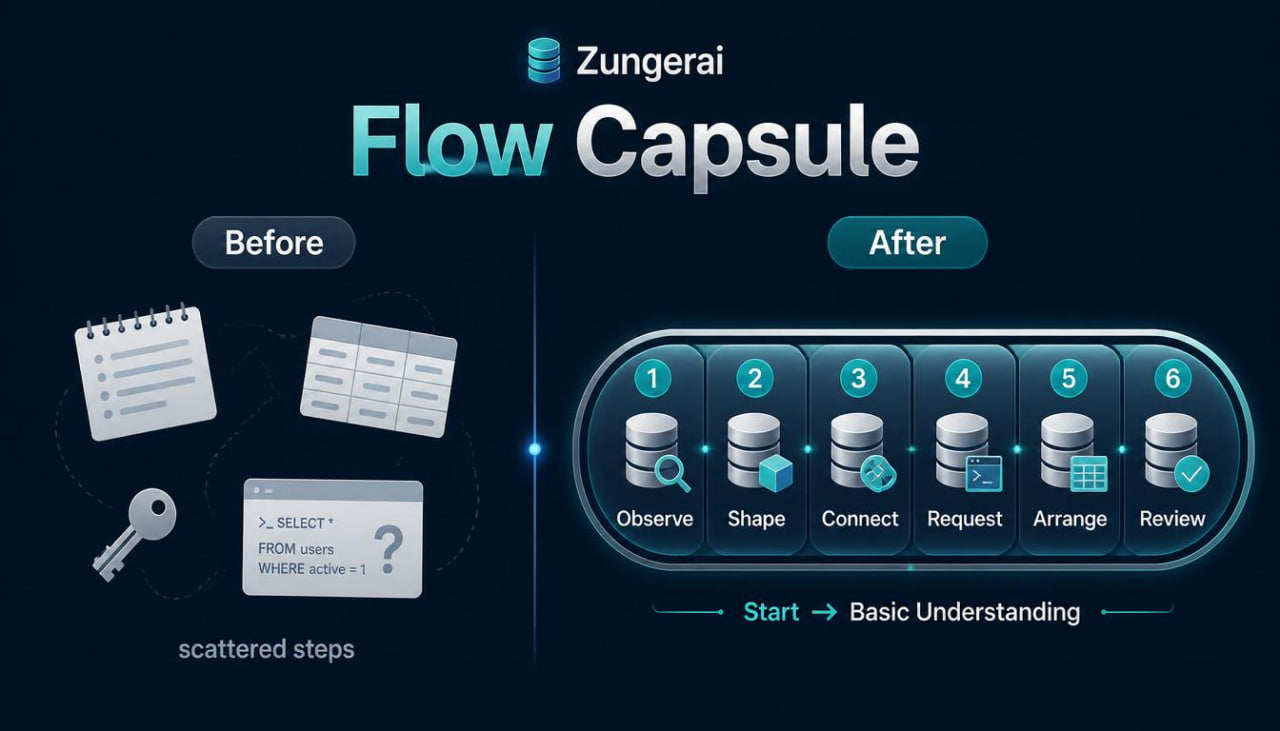
At this stage, learners may understand database parts separately but still need help seeing how a full data structure comes together. Tables, fields, keys, relationships, filters, and query results can feel like separate topics when they are not studied as one connected process. Learners may also struggle to move from a rough information list into a cleaner database outline. Another common difficulty is reviewing a query result and knowing whether it matches the original request. Flow Capsule is created for learners who need a guided course tier that connects database planning with database reading.
- Solution
Flow Capsule presents database study as a connected sequence from information review to result interpretation. The materials explain how to inspect raw notes, define table subjects, choose fields, connect records, form query requests, and review returned results. Each section combines explanation, sample structure, study prompts, and recap notes. The course uses calm language and practical examples rather than loud claims. This tier gives learners a compact but detailed way to study how database decisions affect later query work.
- What’s Inside
Flow Capsule includes detailed database learning materials organized around one central idea: data should move through a clear structure. The course begins with a guided introduction to information review. Learners study rough lists, simple notes, repeated values, unclear categories, and mixed details. The goal of this first section is to show that database planning starts before tables are created. Learners are asked to look at information and ask careful questions: What subject is being described? Which details repeat? Which values describe the same type of thing? Which items belong together?
The next section focuses on table subjects. Learners study how one table should describe one main type of record. Examples may include learners, tasks, categories, items, notes, orders, entries, or schedules. The course explains that a table becomes easier to read when its purpose is narrow and clear. Learners practice naming table subjects and separating mixed information into cleaner table groups. This section also introduces the idea that a database is not only a set of tables, but a planned arrangement of related subjects.
Flow Capsule then moves into field design. Learners review how columns describe one type of detail about each record. The materials show how a field can hold a title, date, status, number, category, reference value, or short description. The course explains why field names should be readable and consistent. It also shows common field issues, such as a field that holds several details at once, a field name that is too vague, or a category value that changes wording across records. Practice tasks ask learners to rename fields, divide crowded details, and choose better locations for certain values.
A section on records follows. Learners study how each row should represent one entry that follows the field structure of the table. The materials explain why records should be consistent within a table. If one row uses a status value, other rows should use comparable status values. If one row stores a date in a certain format within the learning example, other rows should follow the same format. This helps learners understand why steady records matter for filtering, sorting, and result review.
Keys are covered with careful detail. Primary keys are introduced as identifiers that help distinguish one record from another. The course explains why repeated names or titles can create confusion when used as identifiers. Foreign keys are then explained as reference values that connect records across tables. Learners study small table sets where one table contains a primary key and another table stores that value as a reference. These examples help learners see how related information can stay separated but still connected.
Relationship study forms a large part of Flow Capsule. Learners review one-to-one, one-to-many, and many-to-many relationships through written diagrams and table sketches. The materials explain each relationship type through plain questions. Can one record connect to one other record? Can one record connect to several records? Can several records on one side connect to several records on the other side? Many-to-many examples include a linking table, with explanations of how paired references connect the two sides.
The course also includes a section on database outline building. Learners move from rough information into table subjects, fields, keys, and relationships. The materials show how to create a written outline before writing query requests. This outline may list table names, field names, key fields, and notes about how tables connect. The purpose is to help learners organize their thinking and create a reference for later review.
Flow Capsule then moves into query logic. Learners begin with plain-language questions, such as “Which records match this category?” or “Which entries should appear after this date?” The course breaks each request into smaller parts: source table, fields to show, condition, sorting choice, and expected result. This method helps learners understand what the query is trying to return before focusing on formal expression.
Filtering is explained with several study examples. Learners explore filters based on category, status, date, number, and matching values. The materials also introduce combined conditions in simple form. A request may ask for records from one category with a certain status, or records after a certain date with a certain label. The course explains how each condition narrows the returned rows. Learners practice identifying which records should remain after a filter is applied.
Sorting is studied as part of result reading. Learners see how a returned set of records can be arranged by date, name, number, category, or status. The materials explain that sorting changes the order of the result, not the stored records themselves. Practice tasks ask learners to choose sorting fields and explain how the order supports the query goal.
A related-table query section introduces requests that need information from more than one table. Learners study how a query may use a key connection to bring related details into one result. For example, one table may store task records while another table stores learner names. The course explains the path between the tables through shared key values. The emphasis stays on understanding the logic of the connection.
Flow Capsule also includes result review tasks. Learners compare original query requests with sample returned results. They check whether the correct fields appear, whether unrelated rows were removed, whether sorting matches the request, and whether related table information is shown correctly. This section helps learners develop careful reading habits.
The final section is a capsule-style guided case. Learners begin with a small messy data scenario, identify table subjects, choose fields, mark keys, describe relationships, write query requests, apply filters, choose sorting, and review sample results. This final case connects the entire tier into one study path.
- Who Is This For?
Flow Capsule is for learners who want a compact but detailed database tier that connects planning with query reading. It may suit learners who already understand basic terms and want to study how those terms work together in a fuller structure. It can be useful for students, self-paced learners, assistants, organizers, and people who work with structured information.
This tier may also fit learners who completed earlier Zunqerai materials and want a course layer with wider practice. The materials are written for learners who prefer examples, written modules, recap notes, and practice prompts. Flow Capsule does not require advanced database background, but it does assume the learner is ready to study several connected ideas in one course tier.
The focus is not on broad technical coverage for every situation. The focus is database flow: how information is shaped, connected, requested, sorted, and reviewed.
- What You Will Learn
- How to inspect rough information before planning tables.
- How to define clear table subjects.
- How to choose fields that match table purpose.
- How to notice crowded or unclear fields.
- How records follow a consistent structure.
- How primary keys identify records.
- How foreign keys connect tables.
- How to read one-to-one, one-to-many, and many-to-many relationships.
- How a linking table supports many-to-many structure.
- How to create a written database outline.
- How to turn plain questions into query requests.
- How filters narrow returned rows.
- How combined conditions shape query results.
- How sorting changes result order.
- How to read query paths across related tables.
- How to compare a query request with a returned result.
- How to study a full database example from rough notes to review.
- 30-Day Refund Note
For paid Zunqerai tiers, a 30-day refund request window may be included in the store policy. Refund handling depends on the store’s written terms, order status, and file delivery conditions. Please read the refund policy on the store before placing an order. This note describes the refund process only and does not make claims about study outcomes.
Self-paced learning overview
- 🗂️ Digital file available after purchase
- 📚 Long-term availability
- 🔐 Secure checkout
- 📝 Content updated in 2026
What format are the Zunqerai materials provided in?
What format are the Zunqerai materials provided in?
Zunqerai database course materials are provided as digital learning files. They are created for reading, study, practice, and review at your own pace. The materials may include modules, written explanations, examples, tables, tasks, recap notes, and glossary-style sections. Each tier has its own content range and topic depth.
Do I need previous database knowledge before studying?
Do I need previous database knowledge before studying?
No previous database study is required for the starting tiers. Some tiers begin with basic ideas such as tables, fields, records, keys, relationships, and query structure. Wider tiers may include more detailed topics, so learners can choose the tier that matches their current study needs. The materials are written to support gradual learning through examples and practice.
How do I receive the materials after placing an order?
How do I receive the materials after placing an order?
After placing an order, the learning files are provided through the store’s delivery flow or order details message. The exact delivery method may depend on the store setup. You can use the provided files for personal study, reading, note-taking, and practice tasks. Each tier description explains what type of materials are included.
Share