Zunqerai
Axis Module
Axis Module
Couldn't load pickup availability
- Problem Statement
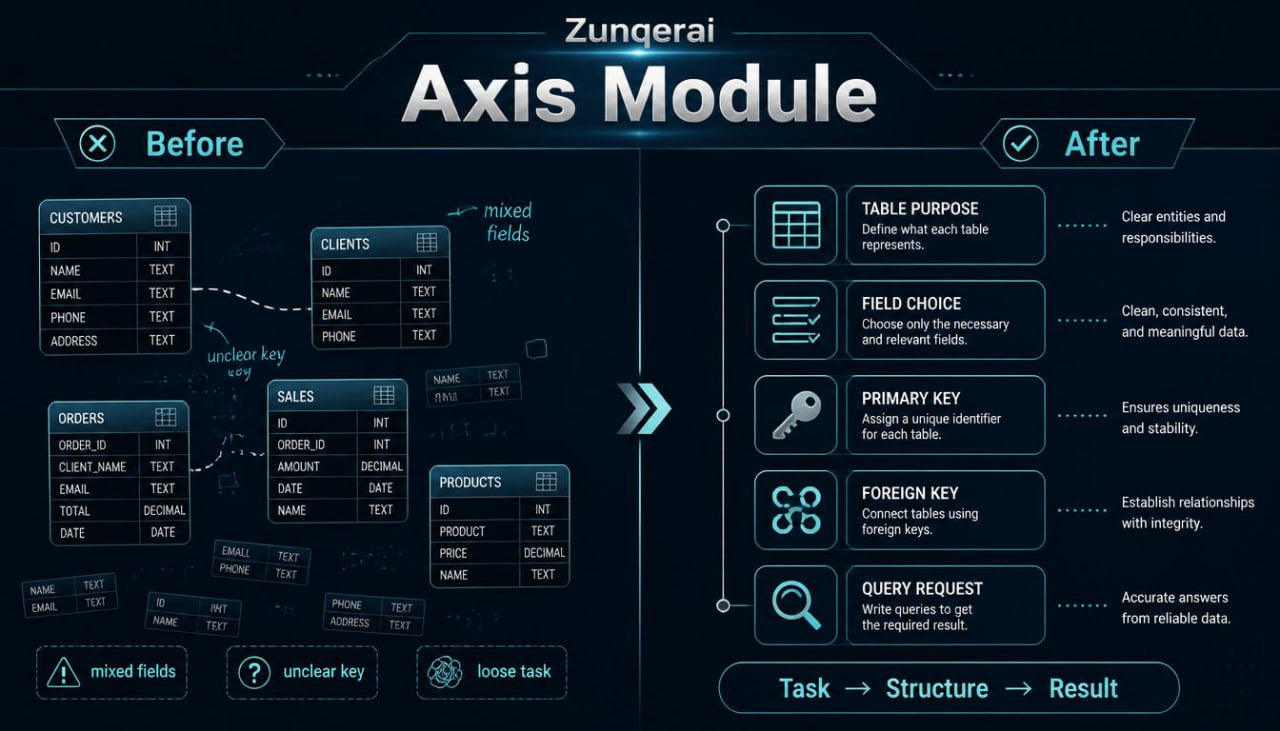
After learning the first database words, many learners still feel unsure about how those ideas connect in a real structure. A table may seem clear by itself, but questions appear when several tables need to work together. Learners may also confuse fields, records, keys, and relationships when examples become longer. Another common difficulty is understanding why database planning matters before writing queries. Axis Module is created for this point, where the learner needs a stronger foundation and more guided practice.
- Solution
Axis Module gives learners a structured path through core database organization. The materials explain how tables are planned, how information is separated into useful groups, and how keys help connect records. The course also introduces query logic through readable examples and practice tasks. Each section builds from a clear idea into a small activity, so the learner can study and review without pressure. This tier helps create a stable base before moving into wider database topics.
- What’s Inside
Axis Module includes a focused set of database learning materials built around structure, order, and early query practice. The tier begins with a review of basic table logic, but it adds more detail than Free Kit. Learners study how a table is not just a place for information, but a planned structure where each column has a role and each row represents a clear entry. The materials explain why a table should describe one main subject, such as customers, books, tasks, orders, or course notes, instead of mixing unrelated details in one place.
The next section explores fields in more detail. Learners see how field names should describe the type of information stored in a column. The materials discuss examples such as name fields, date fields, category fields, status fields, and numeric fields. This part also explains why unclear field names can make a table harder to read later. Instead of using abstract theory only, the course gives small table examples and asks learners to identify which fields are clear and which ones need better naming.
Axis Module also includes a section on records. A record is explained as one full entry inside a table, made from several fields. The learner studies how each record should follow the same structure as the others in the same table. For example, if one table stores book information, each row should describe one book using the same set of columns. This section helps learners see how consistency supports cleaner database reading and later query work.
A larger part of this tier is dedicated to keys. The materials introduce primary keys as values used to identify records inside a table. Learners see why names, titles, or repeated labels may not be reliable identifiers. The course explains how a clear key can make records easier to reference, connect, and update. It also introduces foreign keys in plain language, showing how one table can point to related records in another table. This topic is handled carefully, with small examples and short practice prompts.
Axis Module also introduces relationships in a more detailed way than the free tier. Learners study simple one-to-one, one-to-many, and many-to-many ideas through written examples. The course does not overload the learner with heavy theory. Instead, it uses practical situations such as learners and assignments, authors and books, categories and items, or orders and order lines. Each relationship type is explained through the question: “What does one record connect to?” This makes the topic easier to reason through during practice.
The tier includes an introductory section on database planning. Learners are guided to think before building tables: What information is being stored? Which items belong together? Which values repeat? Which table should hold each type of detail? The course explains that planning can reduce confusion when a database grows. It also shows how rough notes can become a table outline.
Axis Module then moves into query thinking. Learners are introduced to selecting fields, reading rows, applying conditions, and sorting results. The materials use plain examples such as finding entries by category, showing only active records, ordering items by date, or reading a smaller set of columns. The course focuses on the logic behind queries, so learners can understand what a query is asking before looking at technical syntax in later tiers.
The course also includes practice tasks. These tasks may ask learners to name fields for a table, choose a primary key, identify a foreign key, describe a relationship between two tables, split a messy information list into cleaner tables, or write a plain-language query request. The practice tasks are designed for study and review. They help learners apply each idea without making the material feel crowded.
Axis Module also contains recap sections at the end of topic groups. These recaps restate the main ideas in compact form. Learners can use them as review notes after reading the full explanations. A glossary section is included as well, covering terms such as table, field, record, primary key, foreign key, relationship, condition, filter, sort, and query.
The final part of Axis Module brings the ideas together in a small database planning example. The learner sees how a simple topic can be broken into tables, fields, keys, and relationships. This closing example is meant to show how the earlier sections fit together as one learning path.
- Who Is This For?
Axis Module is for learners who already want more than a first introduction, but still prefer calm and structured explanations. It is suitable for people who understand that a database uses tables but want to learn how those tables are planned and connected. It can be a good fit for self-paced learners, students, assistants, organizers, small teams, or anyone who handles structured information and wants to understand database logic more clearly.
This tier is also useful for learners who started with Free Kit and want the next course layer. It does not assume deep technical knowledge. The writing stays focused on concepts, examples, and practice tasks. Learners who prefer written study materials, organized modules, and review notes may find this tier a practical next step.
Axis Module is not written as a complete database reference. It is a foundation tier. It focuses on the main structural ideas that prepare learners for broader topics in later Zunqerai tiers.
- What You Will Learn
- How to describe the purpose of a database table.
- How to choose clear fields for a table.
- How records are structured inside rows.
- Why consistent table design matters.
- How primary keys identify records.
- How foreign keys connect tables.
- How to recognize simple relationship types.
- How to separate mixed information into cleaner tables.
- How to outline a small database before building it.
- How to think through basic query requests.
- How filtering and sorting change query results.
- How to review database terms through glossary notes.
- How to connect table planning with query thinking.
- 30-Day Refund Note
For paid Zunqerai tiers, a 30-day refund request window may be listed in the store policy. Refund handling depends on the store’s written terms, order status, and file delivery conditions. Please read the refund policy on the store before placing an order. This section is written as a policy note, not as a claim about study results.
Self-paced learning overview
- 🗂️ Digital file available after purchase
- 📚 Long-term availability
- 🔐 Secure checkout
- 📝 Content updated in 2026
What format are the Zunqerai materials provided in?
What format are the Zunqerai materials provided in?
Zunqerai database course materials are provided as digital learning files. They are created for reading, study, practice, and review at your own pace. The materials may include modules, written explanations, examples, tables, tasks, recap notes, and glossary-style sections. Each tier has its own content range and topic depth.
Do I need previous database knowledge before studying?
Do I need previous database knowledge before studying?
No previous database study is required for the starting tiers. Some tiers begin with basic ideas such as tables, fields, records, keys, relationships, and query structure. Wider tiers may include more detailed topics, so learners can choose the tier that matches their current study needs. The materials are written to support gradual learning through examples and practice.
How do I receive the materials after placing an order?
How do I receive the materials after placing an order?
After placing an order, the learning files are provided through the store’s delivery flow or order details message. The exact delivery method may depend on the store setup. You can use the provided files for personal study, reading, note-taking, and practice tasks. Each tier description explains what type of materials are included.
Share